
Oh My Zsh gets a proper web page
It was a long time coming… but we finally got a web page designed and deployed for Oh My Zsh.
Check it out! (and tell your friends to ditch bash)
It was a long time coming… but we finally got a web page designed and deployed for Oh My Zsh.
Check it out! (and tell your friends to ditch bash)
Over on the Planet Argon blog, you can read an enlightening interview with two of our Jr. Ruby on Rails developers. Both of them made a career change in their 30s and went through a coding academy here in Portland, Oregon.

We’re all excited about the prospect of a new code editor (Atom Editor). We all love what Github has produced so far and our expectations for anything new are going to be quite high.
Do we know exactly what it’ll be yet? Not quite. We have some hints… but until it’s released… we’ll continue to speculate.
While I am not one to make predictions—I do have a few theories about what Atom will not do for us. (if you’re looking for a new business idea… feel free to snag any of these)
1. Atom Editor will not make it easier to code while in the shower. While I would love to take advantage of putting my thoughts to code while letting my conditioner do it’s thing… I don’t believe they’re trying to solve this problem (yet).
2. Atom Editor is not going to make it difficult for me to produce shitty code. To date, nearly every code editor on the market is focused on making it easier to produce code…. good AND/OR bad. Where is the editor that tells us to quit while we’re head. “Are you serious, Robby? Have you seen what you’ve been writing today? Just stop. Go outside. Take a break and try again tomorrow.”
3. Atom Editor will not bring synergy to developers.
4. Atom Editor will not change the music playing to compliment the coding problem that I’m faced with. If my tests aren’t passing… I wish my music would keep me calm and focused. This is not a time to start playing WHAM! (…or maybe it is)
5. Atom Editor will not bring about peace in the Emacs vs Vim wars. We are going to have to let them sort a peace deal on their own.
6. Atom Editor will not have integrated CVS or Subversion support when it is released.
7. Atom Editor will not promise the world to you like Visual Studio.NET did back in 2002. I remember their demo videos and it seemed like the development world was about to change! I never would have guessed that come 2005, I’d be in love with something as simple and fancy-feature-less as TextMate.
8. Atom Editor will not just be a clone of Sublime Editor. Github has too clever a team for that objective.
What are you confident that Atom Editor will not be?
8 for 8!
funny how Twitter warned me that a bunch of my friends at GitHub are all a sudden interested in https://t.co/cb52btuPZe
— Matt Aimonetti (@mattetti) February 26, 2014
…which leads us to

Initial sources suggest that will be one of the biggest app releases of the year.
It’ll be loved by many. Hated by some.
For more details… visit Atom.io or Atom Beta
Dear \@ohmyzsh users… we are ready! ;-)
As we learn more… I will try to keep this updated. Here are a few “screenshots” people have posted on twitter.


Some animated gifs:


Stay tuned…
SOON.
— Tom Preston-Werner (@mojombo) February 26, 2014
You might consider following @AtomEditor on twitter.
It’s been an odd day. The sort of day where you really don’t know what to say. The only thing you can manage to get out is, “Sigh. I’m going to miss him.”
Jim Weirich was building interesting stuff with Ruby several years before I was introduced to it. Tools that most of us have taken for granted. Tools that were just there.
Before Jim came along… they didn’t exist.
Back in the early Ruby on Rails explosion era (circa 2004-2006), it was much easier to get to know the great Rubyists. I remember finally getting a chance to meet Jim (and _why) at FOSCON here in Portland, which still goes down as one of the best “conferences” I have ever attended.
(I think we all knew something special was happening.)
Jim spoke at a ton of conferences. At any conference that I seemed to get invited to speak at… Jim seemed to always be on the speaker list too. We’d end up meeting up on the conference circuit a several times over the coming years. It was always a delight to catchup.
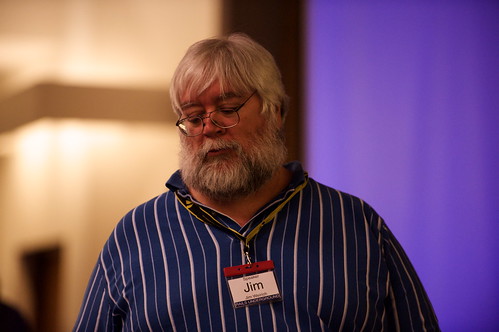
Photo by Obie from Rails Underground
2009
I believe the last one was in 2009 at Rails Underground in London. I remember walking in one of the rooms and spotting Jim. There he was… waiting patiently for his time slot… sitting by the wall in another horribly uncomfortable conference chair… hacking away on his laptop as if he was on a mission to save the human race. In reality, he was probably toying around with some new idea.
As I walked towards him… my red hair must have caught the corner of his eyes… because he looked up and with the warmest of smiles and kindest of voices said, “Robby!”
It’s people like Jim that helped me feel like I had something valuable to contribute to the community. The mere fact that he knew who I was, that he commented on my silly blog posts, referred potential customers to me, showed up for and complimented me on my talks, asked ME for advice on IRC, wished me a happy birthday on Facebook, responded to my lazy tweets… made me feel like I was welcome to (and part of) the party.
A party that started a number of years before I showed up.
Let us raise our glasses high and thank our host for the pleasure of being amidst his most generous company.
Thank you, Jim, for helping me learn more about myself. I only wish I had gotten to know you more.
We’ve had a number of clients in New York over the years. After a recent trip this last fall to visit clients and attend “Cultivate”:, we decided that we should spend more of our time in the city.
In 2014, we’re looking to expand our client base there. If you’re in the NYC area and are looking for an agency that has great Ruby on Rails developers… get in touch.
Earlier today, I noticed that we now have over 500 developers from around the globe who I have accepted pull-requests from[^1^](#fn1){#fnref1 .footnote-ref role=”doc-noteref”}. That is so fantastic.

Thanks to each and every one of you who has helped make this project so wonderful for others. :-)
Recently, I found myself re-installing everything from Homebrew and began to notice that MySQL was consuming nearly half a gig of memory. Given that I don’t do too much with MySQL on a regular basis, I opted to override a handful of default configuration options to reduce the memory footprint.
As you can see, a fresh MySQL install via homebrew was consuming over 400mb of memory.

Here is how I reduced my memory footprint:
$ mkdir -p /usr/local/etc
Unless you already have a custom MySQL config file, you will want to add one into this directory.
$ vim /usr/local/etc/my.cnf
We’ll then paste in the following options into our file… and save it.
# Robby’s MySQL overrides
[mysqld]
max_connections = 10
key_buffer_size = 16K
max_allowed_packet = 1M
table_open_cache = 4
sort_buffer_size = 64K
read_buffer_size = 256K
read_rnd_buffer_size = 256K
net_buffer_length = 2K
thread_stack = 128K\
Finally, we’ll restart MySQL.
$ mysql.server stop
If you have MySQL setup in launchctl, it should restart automatically.
After I did this, my MySQL instance was now closer to 80mb.

So far, this has worked out quite well for my local Ruby on Rails development. Mileage may vary…
Having said that, how much memory are you now saving?
Hey all,
It’s been a while (most of my blogging is over on the Planet Argon blog..). but I’m hoping to have some technical-related posts coming in the near future.
If you’ll be at LessConf in Florida this week, I’ll be there. Do I owe you a drink?
Also, if you’re coming to visit Portland for RailsConf 2013 and will arrive the weekend before, you should join us on a hike. If you can’t make it, be sure to say hello at the conference!
Hope all is well!
Cheers,
Robby
A few months ago we invited the Ruby on Rails community to participate in our hosting survey. We’ve since published the results and created an infographic.
To learn more, check out the Rails Hosting site.
It’s been several years since I released GoogleAnalyticsProxy, which allows our team to test their GA event/click/view tracking during the development phases of our project. Today, I pushed a quick update to it with a minified version of the JavaScript so that there is a smaller footprint.
For more information on how we use it, read my older post, Tracking Google Analytics events in development environment with GoogleAnalyticsProxy.
You can follow along with some of my writing at the following sites:
